
Google Ads
DYNAMIC SEARCH ADS ARE MOVING TO AI MAX

In short: Google is ending Dynamic Search Ads as their own kind of ad. Starting in February 2027, those campaigns move to AI Max on their own. Do you run Google Ads for a roofing, plumbing, HVAC or auto repair business? Then you have a choice. Set it up your way now. Or let Google do it for you later.
Google put it in writing: “starting in February 2027, campaigns using Dynamic Search Ads (DSA) will automatically be upgraded to AI Max.” (Google Ads Help) Owners are asking about it too. “Dynamic search ads” gets about 210 searches a month in the US. People search “google ads for plumbers” about 210 times too. Those numbers come from DataForSEO in October 2026.
Here’s what is changing, where it costs you money, and what to do first.
What are Dynamic Search Ads?
Dynamic Search Ads are Google ads built from your website. You don’t pick the words. Google reads your pages. Then it picks which searches show your ad. It also writes the headline. And it picks the page people land on. All you add is a short description. (Google Ads Help)
Lots of contractors set one up years ago as a catch-all. It finds searches your other ads miss. Then nobody looks at it again.
What is AI Max for Search?
AI Max isn’t a new kind of campaign. It’s a set of tools you turn on inside a normal Search campaign. (Google Ads Help) Google took it out of testing, called beta, in April 2026. (Google)
It has three parts.
| Part | What it does | What to watch |
|---|---|---|
| Search term matching | Shows your ad on more searches than your keywords cover. It uses broad match and your website. Broad match lets Google show your ad on searches that are only close to your words. | Clicks from searches you would never pay for. |
| Text customization | Writes ad text from your ads and your website. Google used to call this automatically created assets. | Ads that say things you didn’t write. |
| Final URL expansion | Sends each click to the page on your site that Google thinks fits best. | Clicks that land on the wrong page. |
Final URL expansion only works when text customization is on. (Google Ads Help)
What is changing, and when?
The dates moved once already. Here’s where things stand.
| When | What happens |
|---|---|
| April 2026 | AI Max for Search comes out of beta. Three things move to AI Max: Dynamic Search Ads, automatically created assets and the campaign broad match setting. (Google) |
| June 11, 2026 | Google pushes the Dynamic Search Ads move to February 2027. You can make new Dynamic Search Ads campaigns again. (Google Ads Developer Blog) |
| September 2026 | Automatically created assets and the campaign broad match setting still move to AI Max on time. (Search Engine Journal) |
| February 2027 | Campaigns still using Dynamic Search Ads move to AI Max on their own. (Google Ads Help) |
So two things are true. Part of your account is likely on AI Max already. And the Dynamic Search Ads part has a few months left.
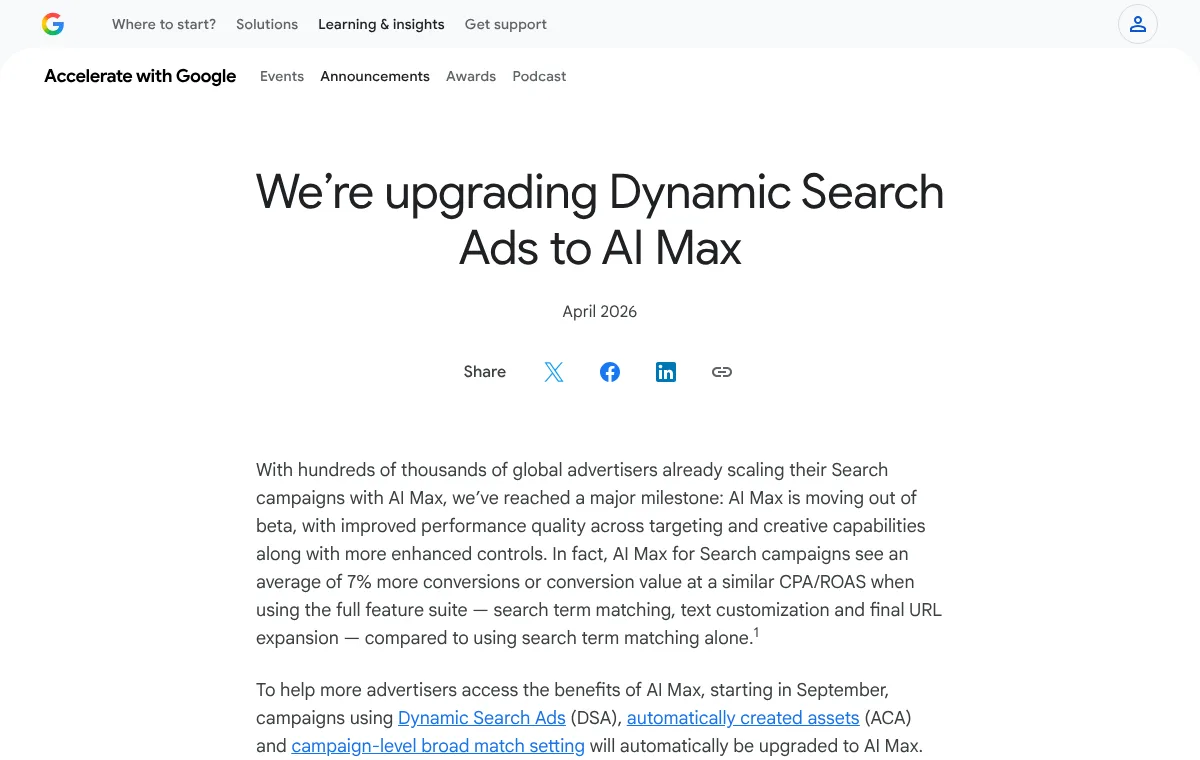
When Google makes the switch, all three AI Max parts get turned on. Your old page rules stay. (Google)
What does AI Max actually do?
Google claims campaigns using all three parts “see an average of 7% more conversions or conversion value at a similar CPA/ROAS” compared with search term matching alone. (Google)
CPA is what you pay for each sale or lead. ROAS is what you get back for each ad dollar. Read that slowly. It’s Google grading its own homework. It covers advertisers outside retail, so not shops. And it’s an average.
A conversion is whatever you told Google to count. Do you count page views or button clicks? Then a 7% lift means nothing for your phone.
Google admits this on its help page: “AI Max won’t be effective if campaigns are limited by budget.” (Google Ads Help) It doesn’t work when your ad money runs out. If your ads run out of money by noon most days, AI Max won’t fix it.
Where AI Max costs a local business money
AI Max isn’t bad. It just needs fences. Here’s where local trades lose money.
Loose matches. Search term matching reaches past your keywords. That finds real customers. It also finds people looking for a job, people who want to do the work themselves, and people in towns you don’t serve. You pay for every one of those clicks.
The wrong page. Final URL expansion picks the page. A “water heater repair” click lands on your blog, your financing page or your jobs page. That person wanted a phone number and a way to book. So they leave.
Ad text you didn’t write. Text customization builds ads from your website. Say an old page says “24/7.” But you stopped taking night calls. That old line ends up in an ad. Old prices and old service areas do too.
Counting the wrong thing. If your conversions aren’t set up as calls and booked jobs, AI Max chases whatever you count.
What to do before February 2027
Most of this takes one afternoon.
- Find your Dynamic Search Ads campaigns. Open Google Ads. Look for campaigns with dynamic ad groups. Write down what each one spends and what it books.
- Check what already moved. Did your campaigns use automatically created assets or the broad match setting? Then part of your account is already on AI Max. Look before you guess.
- Make the switch yourself. Don’t wait for the automatic upgrade. Moving now lets you build the fences first. Pick a slow week to do it.
- Block pages that should never get a click. In Google Ads, you can exclude pages for a whole campaign. Start with your jobs page, blog, privacy page, terms page and old sale pages.
- Set your service area. AI Max has a “locations of interest” setting for each ad group. Use it. Then a search for another city won’t get your ad.
- Read your search terms every week for a month. Search terms are the real words people typed before they clicked. Block the bad ones with negative keywords. Those are words you tell Google to skip. Our ten-minute negative keyword check shows you how.
- Count calls and booked jobs. Make sure a conversion means a call or a form from a real customer. Then judge AI Max on booked jobs, not clicks.
Does Google Ads keep leaking money no matter what you do? Then compare it with Google’s pay-per-lead ads. We break that down in Local Services Ads vs Google Ads.
Want someone to handle it?
We run Google Ads for service businesses. That means search terms, landing pages and call tracking. We judge it all on booked jobs.
Want the whole system done for you? That means ads, landing pages, follow-up and booking. That’s Demand Flow. Then you pick how you pay: The $100K Guarantee, $100,000 in new revenue in 90 days or you don’t pay us, or Pay Per Appointment, $250 for every appointment we put on your calendar.
YOU MAY LIKE THIS
 Local Services Ads vs Google Ads: Which One for El Paso Trades?Oct 19, 2026
 Answering Service for Plumbers and HVAC: Book the Emergency, Not the MessageNov 1, 2026
Questions
Are Dynamic Search Ads going away?
What is AI Max in Google Ads?
Should I turn on AI Max?
Does AI Max work on a small budget?
Can I stop AI Max from sending clicks to the wrong page?
What happens if I do nothing?
Download your free book now
This $7 Million Marketing Playbook can get you more calls from the people already looking for you, in most cases WITHOUT spending another dollar on ads.