
Content Creation
CONTENT PILLARS FOR SMALL BUSINESS: TURN CUSTOMER QUESTIONS INTO POSTS

In short: Content pillars are the few subjects you keep coming back to because they help your customers. Start with the questions people already ask you, sort them into four buckets, and you’ll never stare at a blank screen again.
You sit down to make a post and end up staring at your phone. Then you post another picture with “Call us today” under it.
Content pillars give you somewhere to start. They’re the subjects you keep covering because they help your customers understand the work and decide what to do.
You don’t need a fancy framework. You need topics you can keep explaining with real examples.
Start with the questions, not the categories
Before you name your content pillars, write down ten questions you’ve heard from customers. Go through your estimates, call notes, emails, and whatever your team answers every week. Take out names and private details first.
A landscaping company’s list might cover drainage, sprinklers, when to plant, upkeep, and why one yard needs different work than the one next door.
Those work because a real customer cares about them. A category called “inspiration” is a lot harder to work with unless you know what you’re helping somebody picture or decide.
Four content pillars you can adapt
This is a worksheet, not a rule.
| Pillar | What the viewer gets | Landscaping example |
|---|---|---|
| Understand the problem | A clear explanation of what they’re seeing | Why water collects in one corner of the yard |
| Compare the options | Help making a decision | Fixing one sprinkler zone vs. replacing part of the system |
| See the work | A look at how you do it | What the crew checks before recommending drainage work |
| Take care of it | Something useful after the job | What to watch for after new planting |
You can use all four without turning every post into a sales pitch. Some posts help people notice they have a problem. Others help somebody who’s already comparing companies.
Make posts for people at different stages
Somebody who just found you needs a different post than somebody about to hire you. Make both.
| Where they are | What to make | Example for a gym |
|---|---|---|
| Just finding out about it | A clear answer to a common question | What happens at your first coached session |
| Comparing their options | A comparison or a walkthrough | Group coaching vs. one-on-one |
| Deciding if you’re the one | Your process, your proof, and the next step | How the first assessment shapes the plan |
Marketers call this the top, middle, and bottom of the funnel. All it really means is: explain it, help them compare, then help them decide. If every post says “buy from us,” you skipped most of the conversation.
Tie these back to your personal brand. If you want to be known for explaining the options clearly, your posts have to actually show the options.
Turn one question into five posts
Take “Why is water pooling here?” You can get several posts out of it without repeating yourself:
- A quick demo showing where the low spot is.
- A talking video on what you need to know before recommending a fix.
- A side-by-side of two common causes. Don’t try to diagnose every yard from a clip.
- A list of photos to take before asking for a site visit.
- A follow-up on what would change your recommendation.
Each one gives a real answer. You can keep coming back to the same topic as long as each post shows a new example, answers the next question, or uses a different format.
Here’s a quick exercise. Pick one topic, three customer questions, and three ways to film it. That’s nine posts. A product business could do the same thing with packaging, shipping, and care, filmed as a demo, a comparison, and a quick Q&A.
Keep the ones that actually help somebody. The point is to make the work easier and give each post a reason to exist.
Build a series you can keep making
A series gives you a familiar format for new information. Keep the subject close to work you do every week.
A few you can adapt:
- One thing to check before you sign the quote. A different detail every episode.
- What this part actually does. One part, tool, or material at a time.
- Two ways to fix the same problem. And when each one makes sense.
- A question from this week’s calls. Answer it without naming who asked.
Before you commit, write down six different episodes. If you can’t come up with a second one, it’s a post, not a series.
A series is easier for your team to keep making, because they already know the format. Build it around a project, a challenge, a weekly lesson, or progress toward a goal.
If you already do something useful every day, start there. An order getting packed, a job getting done, a product getting made. Film it, then talk over it and explain the decision behind that day’s work.
Keep an idea bank your team will actually use
Make a shared doc with these columns:
| Customer question | Pillar | What we can show |
|---|---|---|
| Why do these quotes have different totals? | Compare the options | A made-up quote comparison, labeled as an example |
| What happens during the inspection? | See the work | A demo of the inspection |
Add two more columns for who explains it and where it’s at: idea, ready to script, needs footage, done.
Write the question the way the customer said it. Put the technical answer under it. That makes it a lot easier to open the video the way your customers already talk.
When ideas are ready, move them into a content calendar. Leave the rest in the bank. Don’t force every idea into next week.
Pick your first four posts
Pick one question from each pillar. Give each post one main answer, one thing to show, and one next step. If the opening is giving you trouble, read the video hooks guide.
After you post, write down what people ask next. Those questions refill the idea bank. That’s a better reason to make the next post than filling an empty box on a calendar.
And when one of these posts starts getting real questions from the right people, that’s your next ad. A post that already worked for free is the cheapest ad test there is. The free marketing playbook shows how we turn those posts into ads.
We can do this for you
You can do everything above yourself. Most owners do not have the hours. Dead River Management builds and runs the marketing for service businesses. We work in El Paso and across the country. You keep running the business. We handle the ads, the landing page, and the follow-up. You judge us on booked jobs, not reports. See Facebook Ads, read about The $100K Guarantee, or book a strategy call.
YOU MAY LIKE THIS
 How to Film Business Videos With Your Phone: A Practical Shot ListOct 18, 2026
 How to Write Video Scripts for Your Business Without Sounding ScriptedOct 18, 2026
 Short-Form Video Hooks: Open With Something Your Customer Cares AboutOct 18, 2026
CASE STUDIES
BECOME OUR NEXT SUCCESS STORY
$100,000 IN NEW REVENUE IN 90 DAYS OR YOU DON'T PAY US.
Our team calls every lead within 5 minutes, follows up, books the appointment and rebooks no-shows. You show up and close the job.
Or skip the guarantee and pay $250 for every appointment we book.
WE LITERALLY WROTE THE BOOK ON…
HOW TO GET AS MANY CUSTOMERS AS YOU CAN POSSIBLY HANDLE
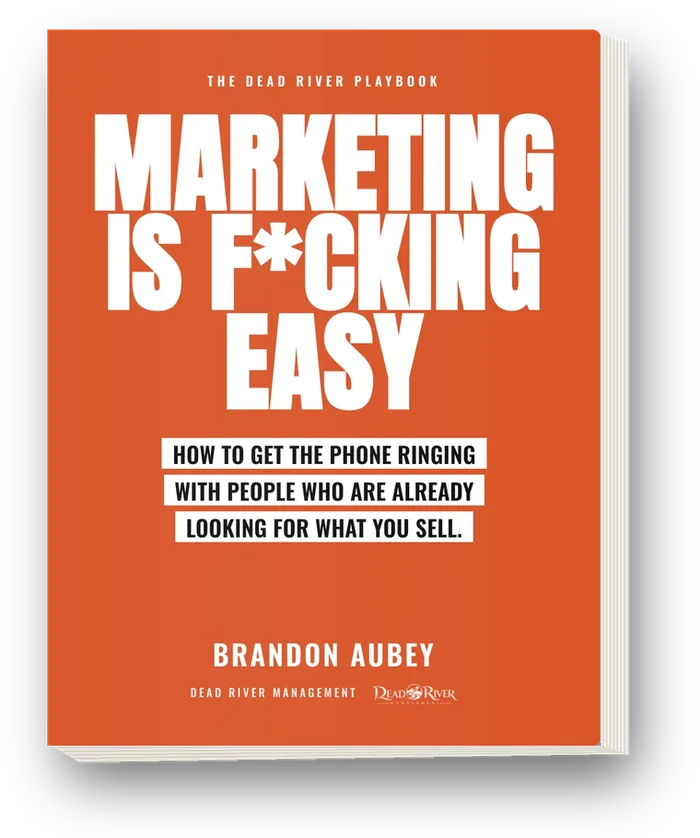
Marketing is F*cking Easy is the playbook we run inside Dead River, written so you can do it yourself. The system, the people already looking, the ads, and your first 90 days. 158 pages, no fluff, straight to what to do Monday morning.
Questions
What are content pillars?
How many content pillars should a small business have?
STILL SCROLLING? JUST HIT THE DAMN BUTTON.
People who are already looking. A phone that actually rings. A guarantee with your name on it.
Download your free book now
This $7 Million Marketing Playbook can get you more calls from the people already looking for you, in most cases WITHOUT spending another dollar on ads.