
Content Creation
HOW TO WRITE VIDEO SCRIPTS FOR YOUR BUSINESS WITHOUT SOUNDING SCRIPTED

In short: If you can explain the work to a customer, you can write the script. Say the answer out loud first, give the video one job, then use the template below to keep the useful part and cut the rest.
If you can explain the work to a customer, you’ve already got a video. The script just helps you keep the useful part and leave out the five other things you thought of halfway through.
Here’s how to write video scripts for your business with questions you already answer every week. One question, something to show, and something the viewer can actually use.
Say the answer before you write anything
Pick a question from your call notes or your content idea bank. Answer it out loud, the way you would if a customer asked you on a normal Tuesday.
Write down the main answer. Keep the words you naturally use. Cut the repeated starts, the tangents, and anything about a customer that doesn’t belong in a public post.
“Here’s what’s included” is a lot easier to follow than a line about your commitment to comprehensive solutions. Use the words you’d actually say.
Steal the structure, not the video
Save good videos from your industry and from businesses near it. Watch what happens in the first few seconds, how the explanation moves, and what makes the ending land.
Then write down the structure. Does it compare two choices? Start with a common mistake? Follow one job from the problem to the result? Answer a few quick questions?
Now put your own information into that shape. A comparison needs two real options and a real difference. A job story needs where it started, what happened, and how it ended.
Keep a simple sheet: the link, the topic, the opening, the format, and what you could explain from your own work. You’re learning how the video is built, then making your own version.
Give the video one job
Write this at the top of the script:
After watching, somebody should understand [one thing] and be able to [do one thing].
For a quote video: “Somebody should understand that the same total doesn’t mean the same work, and know three questions to ask before picking a company.”
If you can’t fit it in that sentence, split it up. A video on picking a company doesn’t also need to cover every material, warranty, and service you offer.
A video script template you can fill in
| Part | What to write |
|---|---|
| Opening | The question, mistake, or comparison your customer cares about |
| Main answer | Your straight answer, in everyday words |
| Example | One real demo, or a made-up example you label as one |
| What changes it | The thing that would change the answer |
| Finish | What they should ask, check, or do next |
Next to each line, write what you’ll show while you say it. More on that below.
If the answer depends on the job, say so in plain words. That’s the detail that helps people make a better decision.
A business video script example you can copy
Here’s one for a service business. Film it with two sample quotes, labeled as examples.
Opening: “These two quotes have the same total. They don’t include the same work.”
Main answer: “Before you pick one, check what they’re supplying, what they’re hauling away, and what happens if they find extra work.”
Example: “This one includes tearing out the old material and hauling it off. This one doesn’t. That changes what you’re actually paying for, even though the totals match.”
What changes it: “The right scope depends on the job. If you can’t compare something, ask the company to explain it.”
Finish: “Put the two quotes side by side before you decide. If something’s missing, ask if it’s included or extra.”
Now the viewer has something to do with what they learned. And they saw how your business thinks about the work.
Swap out the words that slow people down
You know the terms because you use them every day. Your customer might be hearing them for the first time.
| Instead of | Say something like |
|---|---|
| “Optimize your content distribution” | “Get more out of the videos you already made” |
| “Improve audience retention” | “Give people a reason to keep watching” |
| “Establish differentiated positioning” | “Explain why somebody should pick you” |
Use the technical word when it actually helps, then explain it. A good example usually does more than another definition.
Match the words to the footage
If the script says “this part,” make sure people can see which part. If you say two options are different, show the difference while you explain it.
Write footage notes next to each line before you film. You might find out you need a part, a quick drawing, or a demo you can’t shoot that day. Better to find that out before the crew packs up.
Use the phone filming shot list to plan it. A talking video works fine, but a good close-up can make the point with fewer words.
Read it out loud before you film
Time yourself reading it, then listen back. A script that looks short on paper can run long.
Check these:
- Does the opening lead to the answer you actually give?
- Would you say these words to a customer?
- Could somebody follow it without knowing your trade?
- Did you show an example, or just repeat the claim?
- Are the numbers, credentials, and service details right?
- Is the ending useful even if they never call you?
If reading every line makes you sound stiff, use the script to prepare and film from short notes. The facts stay the same. You just sound like yourself.
Match the ending to the video
The next step should come out of what you just explained. If you showed a checklist, tell them to save it. If it’s a series, tell them what the next one covers. If you explained a service and who it’s for, tell them how to learn more.
Give them one thing to do. You don’t need to ask for a follow, a comment, a share, a download, and a sale in the same sentence.
The same script rules work for ads. One idea, one person, plain words, and a button that just says “Learn more.” That’s how we write the ones we run in our Facebook ads work, and the free marketing playbook breaks down every part.
Make the next script better with real questions
After you post, save the questions people ask. If a bunch of viewers get the same point wrong, fix the explanation before you blame their attention span.
Write down what you noticed in your content audit. Then put the next good question on your content calendar.
You don’t need a new personality for the next video. You need another clear answer your customer cares about.
We can do this for you
You can do everything above yourself. Most owners do not have the hours. Dead River Management builds and runs the marketing for service businesses. We work in El Paso and across the country. You keep running the business. We handle the ads, the landing page, and the follow-up. You judge us on booked jobs, not reports. See Facebook Ads, read about The $100K Guarantee, or book a strategy call.
YOU MAY LIKE THIS
 Content Pillars for Small Business: Turn Customer Questions Into PostsOct 18, 2026
 How to Film Business Videos With Your Phone: A Practical Shot ListOct 18, 2026
 Short-Form Video Hooks: Open With Something Your Customer Cares AboutOct 18, 2026
CASE STUDIES
BECOME OUR NEXT SUCCESS STORY
$100,000 IN NEW REVENUE IN 90 DAYS OR YOU DON'T PAY US.
Our team calls every lead within 5 minutes, follows up, books the appointment and rebooks no-shows. You show up and close the job.
Or skip the guarantee and pay $250 for every appointment we book.
WE LITERALLY WROTE THE BOOK ON…
HOW TO GET AS MANY CUSTOMERS AS YOU CAN POSSIBLY HANDLE
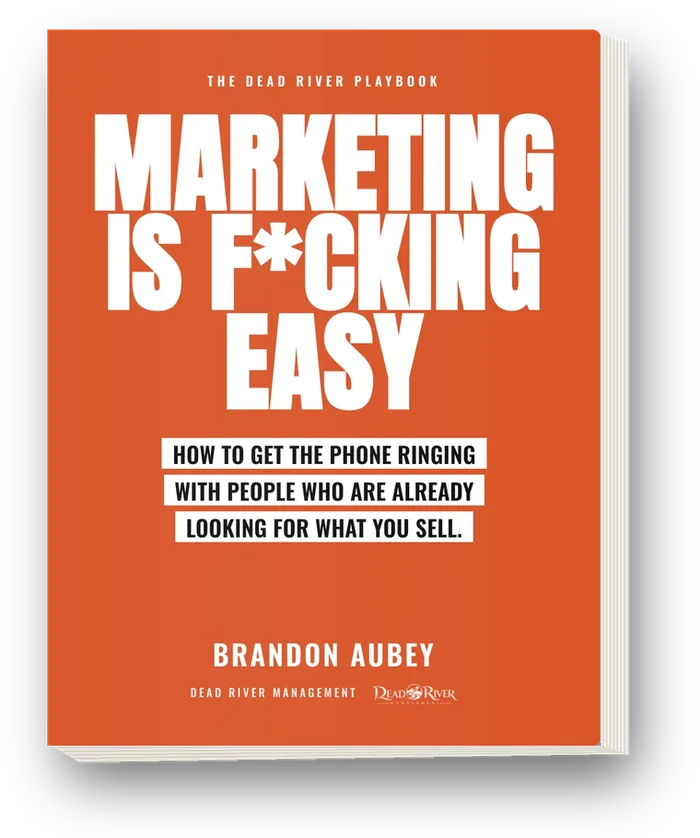
Marketing is F*cking Easy is the playbook we run inside Dead River, written so you can do it yourself. The system, the people already looking, the ads, and your first 90 days. 158 pages, no fluff, straight to what to do Monday morning.
Questions
How do I write a video script that sounds natural?
How long should a short business video script be?
STILL SCROLLING? JUST HIT THE DAMN BUTTON.
People who are already looking. A phone that actually rings. A guarantee with your name on it.
Download your free book now
This $7 Million Marketing Playbook can get you more calls from the people already looking for you, in most cases WITHOUT spending another dollar on ads.